Wednesday, October 6, 2010

Discussing The Graveyard Book and Author Neil Gaiman

I distinctly remember the moment when I decided that Tim Burton was a creative genius and that I would be a devote follower of his work.  And, no, the moment did not involve Edward or his scissored hands.  It was Corpse Bride, actually, and his unique attitude toward the relationship between life and death.  Burton's movie describes a underworld full of characters and color, much more lively than the living residents above.  Burton challenges the traditional beliefs and fears about the dead and decaying that reside below us.

Similarly, but with a flare and voice all his own, Neil Gaiman tackles the theme of life and death in his book, The Graveyard Book.

Now, I'm really not the best at reviewing books.  To be honest, it is a new art form for me.  So, I will not call this or any other post I do a book review.  Rather my reactions to the discussion.  So often, tonight included, I feel I am sitting at the feet at some truly remarkable women in our group.  Their passion for books leaves me in awe and thier understanding of books makes me want to learn more.

Having read the book over a year ago, the details I remember are vague at best, but listening to the group gush over small, delightful details reminded me of why this book brought me so much joy.  The characters were completely believable.  And Emily led us through a rather exciting discovery about Silas that left us all slightly dumbfounded.

I'm starting to realize that I need to learn how to read.  I know that sounds silly, but there is so much more to these stories!  It's completely exciting to me.
 
When I read Coraline a few months ago, I came across this quote by G.K. Chesterton
"Fairy tales are more than true; not because they tell us that dragons exist, but because they tell us that dragons can be beaten." 
 As I read this I could not help feel this was a glimpse into Neil Gaiman and other creative minds that thrive on slightly macabre themes.  Is that what draws me to them?  The idea of facing fears instead of shrinking away.  Are these creative minds showing me a new perspective on fear that I tend to overlook?

The Graveyard Book is charming despite the dark overtone.  Bod works through many new experience with the help of his adopted family.  Once again, the dead are portrayed as warm, friendly, and protective of little Bod.  Authors like Gaiman and Directors like Tim Burton challenge our views and get us to accept and, in some cases, love those things we previously feared. 

Thank you Neil and Tim...Carry on!


The discussion was great and the food was good.  All in all, it was a good time. We missed all those who couldn't come!  Hope we see you next time!

Monday, October 4, 2010

October Book

We'll be discussing The Graveyard Book by Neil Gaiman on Tuesday, October 5th at 8pm.

Nobody Owens, known to his friends as Bod, is a normal boy.

He would be completely normal if he didn't live in a sprawling graveyard, being raised and educated by ghosts, with a solitary guardian who belongs to neither the world of the living nor of the dead.

There are dangers and adventures in the graveyard for a boy - an ancient Indigo Man beneath the hill, a gateway to a desert leading to an abandoned city of ghouls, the strange and terrible menace of the Sleer.

But if Bod leaves the graveyard, then he will come under attack from the man Jack—who has already killed Bod's family. . . .

Beloved master storyteller Neil Gaiman returns with a luminous new novel for the audience that embraced his New York Times bestselling modern classic Coraline. Magical, terrifying, and filled with breathtaking adventures, The Graveyard Book is sure to enthrall readers of all ages.

Winner of the 2009 Newbery Medal and the 2009 Hugo Award.

Summary by BookBrowse

Thursday, August 19, 2010

Joy in the Morning

Maren's pick for September is Joy in the Morning by Betty Smith.

Book club will meet at Maren's house on Wednesday, September 22nd at 8pm. (note the change in date!!)

In Brooklyn, New York, in 1927, Carl Brown and Annie McGairy meet and fall in love.Though only eighteen, Annie travels alone to the Midwestern university where Carl is studying law to marry him. Little did they know how difficult their first year of marriage would be, in a faraway place with little money and few friends. But Carl and Annie come to realize that the struggles and uncertainty of poverty and hardship can be overcome by the strength of a loving, loyal relationship. An unsentimental yet uplifting story, Joy in the Morning is a timeless and radiant novel of marriage and young love.

Summary provided by Amazon.com

Tuesday, July 20, 2010

The Help

The August pick is such a hot book right now and from what I hear, rightly so.
 Melissa has chosen The Help by Kathryn Stockett.

Three ordinary women are about to take one extraordinary step. Twenty-two-year-old Skeeter has just returned home after graduating from Ole Miss. She may have a degree, but it is 1962, Mississippi, and her mother will not be happy till Skeeter has a ring on her finger.

Skeeter would normally find solace with her beloved maid Constantine, the woman who raised her, but Constantine has disappeared and no one will tell Skeeter where she has gone.

Aibileen is a black maid, a wise, regal woman raising her seventeenth white child. Something has shifted inside her after the loss of her own son, who died while his bosses looked the other way. She is devoted to the little girl she looks after, though she knows both their hearts may be broken.

Minny, Aibileen’s best friend, is short, fat, and perhaps the sassiest woman in Mississippi. She can cook like nobody’s business, but she can’t mind her tongue, so she’s lost yet another job. Minny finally finds a position working for someone too new to town to know her reputation. But her new boss has secrets of her own.

Seemingly as different from one another as can be, these women will nonetheless come together for a clandestine project that will put them all at risk. And why? Because they are suffocating within the lines that define their town and their times. And sometimes lines are made to be crossed.

In pitch-perfect voices, Kathryn Stockett creates three extraordinary women whose determination to start a movement of their own forever changes a town, and the way women — mothers, daughters, caregivers, friends — view one another.

A deeply moving novel filled with poignancy, humor, and hope, The Help is a timeless and universal story about the lines we abide by, and the ones we don’t.


summary by Goodreads 

Dropouts meeting for August will be Tuesday, August 3rd at Melissa's house.

Tuesday, June 8, 2010

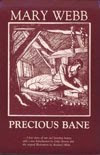
Precious Bane

The book for July is Precious Bane by Mary Webb.  
Set in the remote hill country of Shropshire at the time of the Napoleonic wars, Mary Webb's classic novel tells a story of superstition and hatred, of destructive ambition, and, most of all, of the strength of love.  Precious Bane was a best-seller of the 1920s.

Precious Bane is the story told by Prudence Sarn.  Afflicted with a "hare-shotten lip," feared and scorned as a witch, Prue Sarn nonetheless possesses a passionate heart and a clarity of sight.  She loves and sees the remote countryside that is her home with a descerning, mystical vision; and she also, hopelessly it seems, loves Kester Woodseaves, the weaver.

Yet Prue is bound to her brother, Gideon Sarn, the sin-eater.  A distraught and driven man, Gideon is cut off from human contact and from the beauty of the natural world by his love of profit, by his hunger to make his farm produce.  And he has made Prue promise to work with him toward an end she does not want-an end that may destroy them both.

Thus Prue is torn between loyalty to her brother and love for the weaver.  In turn, Kester Woodseaves' steady love for all created things leads him to resist people's destructive cruelty toward nature and each other; and his love for Prue Sarn enables him to discern, beneath her blighted appearance, the natural loveliness of his "dear acquaintance."  

Precious Bane tells the story of these several loves, of their conflict-and consummation.


Summary taken from1980 publication of Precious Bane.


I wasn't sure who had what publication but mine had a really insightful introduction by author Erika Duncan.  If you don't have it in your book, I've taken the liberty (hopefully not too much liberty) to scan in my introduction.  I had no idea how many treasure this story.  After reading it I was really excited to dive into Precious Bane.  

See you all next month!


(Click pages to enlarge)


Monday, June 7, 2010

June's Meeting

Thanks to Shelley for hosting June's gathering. We had a good turnout and the cheese and cookies were yummy.

Here's a few of my thoughts regarding the book.

While nonfiction, it read like a story. It was compelling. It was sad. It was gross (you who have read it know what I'm talking about).

Dr. Minor (the madman who contributed so incredibly to the dictionary) suffered acutely for many years in confinement. His nights were filled with the torture of hallucinations, paranoia, and fear. Treatment for his mental illness was largely absent, and so his work on the dictionary became his therapy.

In the words of the author:
One must feel a sense of gratitude, then, that his treatment was never good enough to divert him from his work. The agonies that he must have suffered in those terrible asylum nights have granted us all a benefit, for all time. He  was mad, and for that, we have reason to be glad. A truly savage irony, on which it is discomfiting to dwell.
While I loved learning about the backgrounds of the two men the book is about, and how their lives prepared them to work on the writing of the OED, my favorite part of the book was the third character: the OED itself.

It's no secret that I love books. And with that love of books and reading has come a love of words. I love to learn new words and use proper (though often uncommon) pronunciation. I like the subtleties of meaning and how words evolve over time. This book helped me understand that language is almost an organic entity. It lives, changes, grows, and some parts of it even die. 

I found the process by which the OED was written to be fascinating. How the language's most comprehensive dictionary could have been compiled in a time before computers. The sheer magnitude of the task is boggling. The men who made it happen are geniuses, and we are indebted to them whether we realize it or not. 

Winchester sums it up thus:
It was the heroic creation of a legion of interested and enthusiastic men and women of wide general knowledge and interest; and it lives on today, just as lives the language of which it rightly claims to be a portrait.

Wednesday, May 19, 2010

Review on Darwin

See Jessica's wonderful review on our last book here.

(I hope Jessica doesn't mind my posting a link to her blog without permission. She is so wonderful that you all ought to know her and read her blog.)

Sunday, May 16, 2010

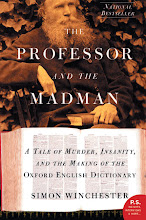
The Professor and the Madman

The Professor and the Madman: A Tale of Murder, Insanity, and the Making of the Oxford English Dictionary Our next meeting will be June 1st, hosted by Shelley.

The Professor and the Madman by Simon Winchester, masterfully researched and eloquently written, is an extraordinary tale of madness, genius, and the incredible obsessions of two remarkable men that led to the making of the Oxford English Dictionary -- and literary history. The compilation of the OED began in 1857, it was one of the most ambitious projects ever undertaken. As definitions were collected, the overseeing committee, led by Professor James Murray, discovered that one man, Dr. W.C. Minor, had submitted more than ten thousand. When the committee insisted on honoring him, a shocking truth came to light: Dr. Minor, an American Civil War veteran, was also an inmate at an asylum for the criminally insane.

(Summary provided by Goodreads.com)

Darwin

Thanks to all who came to our May meeting. It was a small gathering, but the food was great and so was the conversation.

It was fun to learn about the man behind the controversial theory of evolution. Whether you believe that humans evolved from animals or not, you can't help but agree that Darwin is a fascinating man. I loved learning about what a kind and sensitive husband and father he was. What a good and caring person.

Getting to know him through this biography has helped me feel a kinship with him. I'm glad to understand him better. I loved learning about his devoted relationship with his wife. It is interesting to learn that though his theories deeply upset her and her devout Christian sensibilities, they didn't let it divide them. He remained supportive of her faith and they continued in their love and marriage to one another.

Another great selection. Thanks for suggesting it, Jessica! I would likely never have picked up this book otherwise, and I am so glad I read (well, to be honest, am still currently reading) it.

Friday, April 2, 2010

Darwin, His Daughter, and Human Evolution

No book club meeting for April. Book choice for May is Darwin, His Daughter, and Human Evolution by Randal Keynes. It has also been republished as Creation: The True Story of Charles Darwin.

In a chest of drawers bequeathed by his grandmother, author Randal Keynes discovered the writing case of Charles Darwin's beloved daughter Annie, who died at the age of ten. He also found the notes Darwin kept throughout Annie's illness, the eulogy he delivered at her funeral-and provocative new insights into Darwin's views on nature, evolution, and the human condition.

(summary provided by Goodreads)

Thursday, March 4, 2010

A Change Worth Noting

We've had a few requests to know the book ahead of time so on the sidebar I've listed the book and hostess for each month. It's pretty self-explanatory, really. Some have not been chosen yet hence the To Be Announced.

We'll still be posting the summary as the new month approaches.

Thursday, February 4, 2010

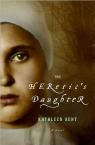
The Heretic's Daughter

The book for March is The Heretic's Daughter by Kathleen Kent.

Martha Carrier was one of the first women to be accused, tried and hanged as a witch in Salem, Massachusetts. Like her mother, young Sarah Carrier is bright and willful, openly challenging the small, brutal world in which they live. Often at odds with one another, mother and daughter are forced to stand together against the escalating hysteria of the trials and the superstitious tyranny that led to the torture and imprisonment of more than 200 people accused of witchcraft. This is the story of Martha's courageous defiance and ultimate death, as told by the daughter who survived.

Kathleen Kent is a tenth generation descendent of Martha Carrier. She paints a haunting portrait, not just of Puritan New England, but also of one family's deep and abiding love in the face of fear and persecution.

Summary provided by Goodreads

My Thoughts on February's Book

We had a great discussion Tuesday. We discussed everything from Ethiopia's prosperous history to the challenges of international adoption. Which is pretty much the span of the book. It was interesting to hear from our two social workers about the subject of adoption and the challenge of attachment when adopting older kids. We tend to romanticize international adoption as a solution to situations like this. We don't quite understand the sacrifice involved to make the adoption a success. It was good to hear a professional's point of view on the subject.

Okay, my thoughts on this book...I found this book completely fascinating. It wasn't a particular fast read for me since so much of it felt like a history lesson in various subjects including the evolution of Ethiopia, the arrival of AIDS, and the frustrating greed of the pharmaceutical companies. These bursts of historical background were juxtaposed withing the emotional story surrounding our heroic, but not perfect, Haregewoin Teferra.

I felt like I was getting the big picture while feeling the impact on the individual. As a result, the author told a complete story of this woman and what exactly she was up against. It tickled my intellectual pallet as well as my emotional one. I thought Melissa Fay Greene did a great job of creating awareness.

Just a few specifics...

Right away I was caught up in the gradual downfall of Ethiopia. Once ruled by the Queen of Sheba and considered one of the great four kingdoms, Ethiopia (then Abyssinia) was powerful and industrious.

I never knew this about Ethiopia. My limited knowledge of said country was only that they were the butt of many jokes growing up. When a joke needed a starving waif that would do anything for food simply insert an Ethiopian and the joke was funny for some reason. Now I get why.

So, once powerful and industrious, now the majority of it's people live on less than $2/day. What happened? Greene goes into detail to portray a series of corrupt leaders who's personal power and wealth far exceed their concern for the people. I can't help but feel very grateful for my country, founded on democracy rather than subject to a king (thanks be to Washington for declining the invitation). Ethiopia tried to instill democracy but unable to achieve it when the powerful won't give up their power or give land to it's people.

The other impression I got from this book is the ghost-like role of parents, particularly mothers. The lack of parents haunt this story. It begins with mothers dropping their babies at Haregewoin's door; their last motherly act before sucombing to their illness. Then the neglect from lack of emotional resources. With so many orphans how can they all feel the love they need. Haregewoin is stretched emotionally thin with so many in need of love. Their eyes start to turn away, empty and unexpectant. My heart broke to read of a toddler left in her stroller all day, forgotton.

The most poignant to me was the author's own experience with the needy mothers outside of Haregewoin's compound. They surround her, calling her "Mama!" wanting anything from her. "Mama! they call me; it is their word of greatest respect and gratitude and it is also a word intended to generate a long term sense of obligation in me." Her only respit is to know that she'll leave this country to go home. But Haregewoin cannot leave or escape the word "Mama!"

In our discussion Maren mentioned her impulse to climb in bed with her children and whisper that she may not be perfect but she'll be there for them. I found this really touching and found myself, once again, grateful that she'll probably be able to keep that promise to them.

During my time reading this book I would get pangs of gratitude for what I have. In fact, I probably have way too much. When I hear people complain about their homes not being big enough I want to hand them this book and tell them to be grateful that you, as a middle-class citizen, don't have to shower outside!

I loved the book. Thought it was hard; awareness always is, but really necessary for me to read. I hope everyone got something from it. If anyone wants to share feel free to comment!
Monday, February 1, 2010

A Hard One

This month's book is tough for me. I'm not going to lie. I'm a total wimp.

I used to be able to learn about the suffering in the world without wanting to close my eyes and plug my ears. I felt empathy and a desire to serve.

Then I became a mother.

Now when I hear about babies who have no one to take care of them, or who wake up to both their parents dead, or whose mothers are so malnourished that they don't produce any milk and so the baby starves too, well, let's just say I weep. I weep. I get a headache from weeping. Then I weep some more.

I would read a few chapters of this book, and then need to resist the urge to wake up my sleeping children and cuddle them and tell them I'll always be here for them.

I am so blessed.

I am SO IMMEASURABLY BLESSED.

And I feel a bit guilty. Why am I so lucky? So easily I could have been born to less privilege, wealth, health, freedom, and opportunity.

So the question is, what can I do?

What can I do to alleviate some of the suffering in the world?

How can I feel only humbly thankful rather than guilty for my numerous blessings?

See you all soon. Looking forward to hearing about your experience with this book.

Thursday, January 7, 2010

There Is No Me Without You

For February we'll be reading There is No Me Without You: One Woman's Odyssey to Rescue Africa's Children by Melissa Fay Greene.

There Is No Me Without You is the story of Haregewoin Tefarra, a middle-aged Ethiopian woman of modest means whose home has become a refuge for hundreds of children orphaned by AIDS. It is a story as much about the power of the bond between children and parents as about the epidemic that every year leaves millions of children, mostly healthy themselves, without family. Originally a middle-class woman with a happy family life, Haregewoin fell into a deep depression after the death of her recently married daughter. But then a priest brought her two children, AIDS orphans, with nowhere to go. Unexpectedly, the children thrived, and Haregewoin found herself drawn back into daily life. As word got out, an endless stream of children began to arrive at her door, delivered by dying parents and other relatives who begged for her help, and, pushing against the limits of her home and bank account, she took more and more in. Today, Haregewoin runs a school, a daycare system, and a shelter for sick mothers. Without medication for her charges—some HIV-positive, some uninfected, and some infants trying to fight off the virus, but almost all of whom come to her terrified and malnourished—she forges on, caring for as many as she can handle. Increasingly, she also places them for adoption with families like that of journalist Melissa Fay Greene, who has two children adopted from Ethiopia. In Haregewoin Tefarra’s story, Greene gives us an astonishing portrait of a woman fighting a continent-wide epidemic.
(summary provided by GoodReads)

We'll be meeting at Jenn's house February 2nd, 8:00pm.

The Great Divorce Discussion

A big thanks to all who came to our discussion of the great divorce. And to Maren who hosted and fed us.

I just wanted to post a few quotes that were brought up in the discussion.


"Hell is a state of mind... But Heaven is not a state of mind. Heaven is reality itself. All that is fully real is Heavenly. For all that can be shaken will be shaken and only the unshakeable remains."

"Ye cannot fully understand the relations of Choice and Time till you are beyond both."

"There are only 2 kinds of people in the end: Those who say to God 'Thy will be done.' and those to whom God says in the end 'Thy will be done.'. All that are in Hell choose it."

"For to be afraid of oneself is the last horror."

"Brass is mistaken for gold more easily than clay is."

Thursday, December 17, 2009

Great Divorce Quotes

What attracts me to a book like this are the many quotable statements. They make me think long after I've read them. I have several but will only post one in hopes that others may have picked up on some favorite quotes during their reading.

This quote is found in the preface. I casually read it months ago when reading this book was just a thought.

"If we insist on keeping Hell (or even earth) we shall not see Heaven: if we accept Heaven we shall not be able to retain even the smallest and most intimate souvenirs of Hell."

I would LOVE to hear what's sticking with your during your reading journey!

Thursday, December 3, 2009

My 2009 Book List

Hi Ladies,

Since I know you are all book addicts, just like me, I thought I'd give you a list of my favourite books that I've read this year.

You can find my list on my personal blog, here.

What have been your favourite books this year?

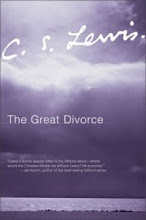
The Great Divorce

Our January selection is The Great Divorce by C.S. Lewis.

The title is in reference to Blake's The Marriage of Heaven and Hell. While Blake believed that the material world and our physical desires are part of the divine order, thus marrying heaven and hell, Lewis describes the divorce between the two.

The Great Divorce is an allegorical study of the psychological difference between the heaven-bound soul and the hell-bound soul.

It begins with the narrator (presumably Lewis) finding himself in a "grey town", a place devoid of joy and colour. The grey town symbolizes hell, and the inhabitants are granted a sort of vacation. They board a train to travel to paradise, and it is on their journey that they discover that they are ghosts, lacking a physical body.

Paradise turns out to be physical and material, but it is painful to the damned souls. The blades of grass are too hard to walk upon, and the leaves are too heavy for them to lift. They are invited to enter paradise properly, presumably through some sort of repentance process. Some accept. Some don't.

Wednesday, December 2, 2009

The Dropout's First Brief Meet

Our first meeting went well despite the first glitch of getting the closing time wrong at the cafe. My vision of everyone spending time getting to know each new face was cut short by a brief inhaling of gelato while throwing out administrative detail to everyone. With only a half hour to bond with my new book club family I felt robbed! However great my disappointment I'm very excited about our group. And our January book! Maren did such a great job introducing the book. I'll coax her into posting it!

Again, first official book discussion at Maren's house January 5th, 8pm. We will email everyone the address.